ما جرى في كراكاس يكشف إلى أي حدّ باتت واشنطن مستعدّة للذهاب، ويُظهر في الوقت نفسه هشاشة المنطق الذي تقوم عليه هذه المقاربة.
From Venezuela to Hormuz: America’s Energy Strategy Enters a Dangerous Phase
Caracas reveals how far Washington is prepared to go - and how fragile the logic may be
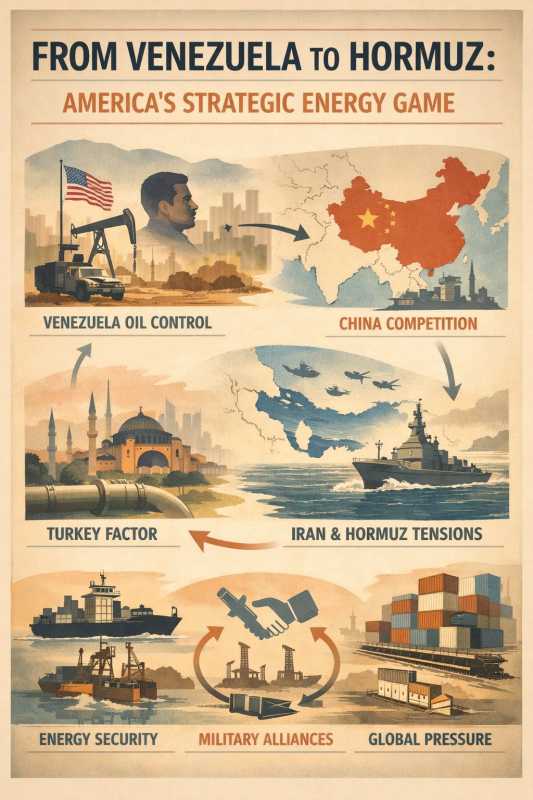
The U.S. operation in Venezuela was militarily contained but strategically expansive. By removing Nicolás Maduro, declaring that Washington will administer the country until an acceptable transition, and tying recovery explicitly to oil control, the Trump administration has exposed a governing logic that stretches well beyond Latin America. What was presented as enforcement or stabilisation now looks increasingly like a test of how far American power can be exercised without formal war - and without the restraints that once accompanied it.
This is not simply about Venezuela. It is about how the United States, under growing pressure from China’s rise and regional instability elsewhere, is experimenting with energy, law and force as substitutes for consensus and legitimacy.
Energy as leverage, not development
For more than a decade, U.S. strategy has rested on a blunt assessment: China is the principal long-term competitor, and preventing Beijing from converting economic scale into strategic dominance requires control over systems rather than territories. Energy sits at the centre of that calculation.
Venezuela’s oil reserves matter less for current supply than for future leverage. The concern in Washington has been that a hostile government, aligned with rival powers, could eventually turn recovery into strategic influence. Sanctions and licensing regimes attempted to manage this risk indirectly. The current approach is more explicit. By framing oil as restitution and asserting custodial authority, the administration has signalled impatience with indirect tools and a willingness to override sovereignty to shape outcomes.
This marks a shift from influence to administration - and from persuasion to enforcement.
The Middle East model, and its limits
The logic visible in Caracas echoes long-standing U.S. practice in the Middle East, particularly in managing pressure on Iran. There, Washington has sought to limit Tehran’s ability to convert geography into leverage around chokepoints such as the Strait of Hormuz, through which a significant share of global oil trade passes. The strategy has relied on sanctions, maritime coalitions and deterrence rather than direct confrontation.
Israel has been central to this architecture. Its integration into regional security frameworks, combined with persistent military action against Iranian-linked targets, has been treated in Washington as a stabilising force.
In practice, however, Israel’s posture has often carried escalation risks that the U.S. then absorbs - diplomatically, militarily and economically.
The assumption that Israel’s security actions reliably serve broader regional stability is increasingly questionable. Repeated strikes, opaque red lines and unilateral escalation have narrowed diplomatic space and increased the risk that energy infrastructure and shipping lanes become entangled in conflict cycles that Washington claims it seeks to avoid.
Managing markets by managing power
Energy coordination with Gulf producers is intended to mitigate these risks. Spare capacity and crisis management are meant to allow pressure on adversaries without triggering price shocks. Engagement with producers elsewhere, including in Africa, reflects the same logic: reduce vulnerability to any single disruption.
Yet this system is brittle. Markets respond globally, not selectively.
Coercive energy strategies invite diversification, accelerating China’s investment in overland routes, alternative suppliers and domestic substitutes. Pressure intended to preserve leverage can, over time, erode it.
Turkey’s position further complicates the picture. As a NATO member controlling critical corridors and involved across multiple theatres, Ankara cannot be neatly aligned or ignored. Managing this ambiguity has become another constraint rather than a source of control.
A strategy born of constraint
What the Caracas operation ultimately reveals is not confidence but limitation. The Trump administration appears sceptical of multilateralism, dismissive of nation-building and impatient with legal or institutional friction. Its answer has been to collapse distinctions: between war and law enforcement, between administration and occupation, between energy security and political control.
This may deliver short-term leverage. But it carries long-term costs.
Custodial power invites resistance. Legal exceptionalism weakens norms the U.S. may later need.
And reliance on partners whose actions escalate rather than stabilise - particularly Israel - increases the risk that energy and security strategies collide.
Bottom line…
From Venezuela to Hormuz, Washington is attempting to preserve primacy in a system where decisive wars are too costly and disengagement too dangerous.
The result is a strategy that feels less like a doctrine than a series of gambles - each justified as unavoidable, and each narrowing the margin for error.
https://open.substack.com/pub/bkrkaraki/p/from-venezuela-to-hormuz-americas?utmsource=share&utmmedium=android&r=5j4reu